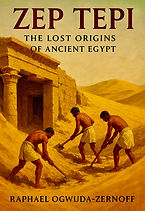
Why This Book Exists
There comes a moment in every civilisation when the official story of the past no longer satisfies the deeper intuition of its people. What we are taught in school, what fills documentaries, what appears in textbooks, begins to feel thin, fragmented, and suspiciously neat. The further we look into the records of the ancient world, the clearer it becomes that the surface explanation does not match the depth of human memory. This book exists for that reason. It is written for those who sense that the history of our world is older, richer, and far more complex than the narrow narrative we inherited.
For more than a century the story of early Egypt has been presented to us as a straightforward progression: a simple tribal culture slowly developing writing, architecture, agriculture, governance, and religion until it blossomed into the civilisation we know today. According to this view, all knowledge emerged locally, all ideas were original to the Nile Valley, and the mysterious references to earlier ages were nothing more than religious imagination. Yet the ancient Egyptians themselves never made this claim. They spoke again and again of a time before their own, a time they called Zep Tepi, the First Time. It was not poetry for them. It was their inheritance.
The people who lived along the Nile did not describe themselves as the creators of civilisation. They described themselves as the heirs of something older, something already established long before their kings ruled. Their temples, their hymns, and their funerary texts all preserve fragments of a memory that reaches beyond the horizon of recorded history. They insisted that the world had experienced cycles of destruction and renewal, and that their knowledge originated in a far earlier age, preserved through catastrophe and carried forward by a priesthood that acted as a bridge between worlds. This book exists to take that testimony seriously.
For too long these ancient voices were dismissed. Modern translators, shaped by the rational and secular worldview of the nineteenth and twentieth centuries, categorised many of these stories as myth. They assumed that ancient people could not possibly have preserved accurate memory of events older than their writing systems. The symbolic language of the temples confused them, so they concluded that the symbolism had no historical content. As a result, what survived into modernity was a shell, a cultural skeleton stripped of its depth. The living history behind the symbols was lost.
Today we stand at a different place. We possess archaeological technologies that allow us to scan landscapes, reveal buried structures, and recognise the age of sites previously believed to be younger. We understand that oral cultures can preserve remarkably accurate information across thousands of years. We recognise that climate change at the end of the Ice Age caused worldwide upheaval, floods, and the collapse of unknown societies. Geological studies confirm rapid shifts that match the ancient descriptions of devastation. Slowly the evidence forms a single picture, and that picture aligns with the old stories that were once dismissed as myth.
This book exists because the ancient world deserves to be read on its own terms. Instead of forcing Egyptian texts into the assumptions of the modern mind, we approach them through the worldview of the people who wrote them. When an inscription says “in the First Time,” we do not translate it into metaphor. We allow it to mean what the writers believed it meant: a reference to a real period in human history, remembered across many generations. When temple walls describe the actions of figures labelled as gods, we consider the possibility that these were remembered ancestors or teachers from an earlier civilisation. When creation accounts appear dreamlike and strange, we recognise that they may encode memories of events experienced by people living in a world very different from our own.
This book also exists because history cannot remain static. New discoveries demand new interpretations. The global pattern is unmistakable. From Egypt to Sumer, from India to Mesoamerica, cultures describe teachers who appeared suddenly, already possessing knowledge of astronomy, agriculture, geometry, medicine, and law. They speak of eras of light before eras of darkness, of floods, fires, and upheavals that reset civilisation. These parallels do not prove every detail, but they point to a shared human memory of something profound. They invite us to question the assumption that civilisation began only a few thousand years ago.
Zep Tepi is one of the clearest and oldest names for that forgotten era. It is the Egyptian doorway into the world before the world. By exploring it with respect, clarity, and discernment, we are not entering fantasy. We are returning to the understanding that the ancients themselves preserved. We are piecing together their worldview, not imposing ours upon them.
This book is written for readers who wish to understand the deep origins of Egypt in a way that feels coherent, intelligent, and grounded. It is not a rejection of scientific inquiry. It is a recognition that science and ancient testimony are no longer in conflict. When read without prejudice, they illuminate each other. It is also not an attempt to romanticise the past. The world before the dynasties was not perfect. It was simply different, shaped by another kind of intelligence, another rhythm of life, another relationship with nature.
Most of all, this book exists because humanity is ready to remember. We live in an age of accelerated rediscovery. The old stories rise again, no longer dismissed, no longer misunderstood. The symbols begin to open, the timelines begin to expand, and the fragments of the First Time begin to align into something whole. When a civilisation reaches this point, the past is not a museum. It becomes a teacher.
Zep Tepi invites us to consider that the greatest mystery of Egypt is not how it rose, but how much it remembered. The answers lie not in superstition, but in the accumulated wisdom of an age erased by time yet preserved in stone. This book is an invitation to read those stones anew, with the clarity of this moment in history and the awareness that the First Time was not a myth. It was a chapter in the human story that has waited patiently for us to return to it.